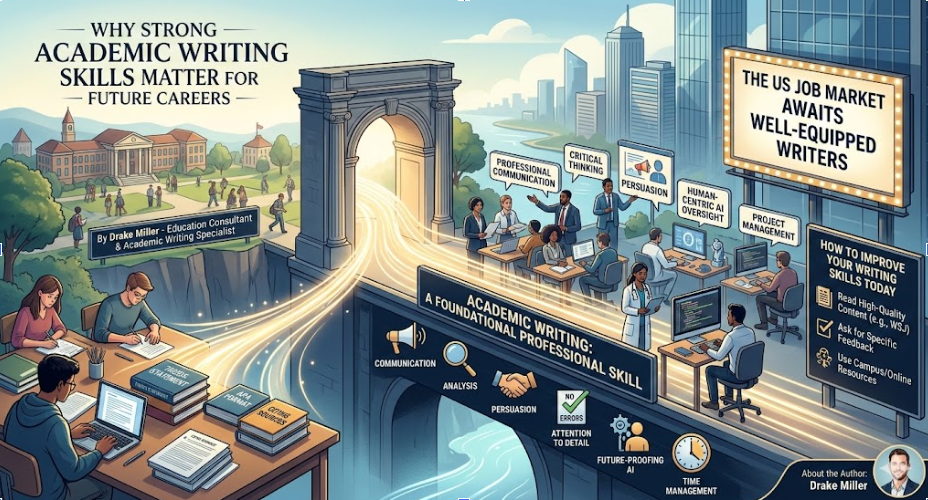
By Drake Miller – education consultant and academic writing specialist
For many high school and college students, the long hours spent refining a thesis statement or citing obscure sources in APA format can feel like a tedious academic exercise. When you’re staring at a blank screen at 2:00 AM, it is easy to wonder: “When am I ever going to use this in the real world?”
The truth is that academic writing skills for students are not just about getting an ‘A’ in Freshman English. It is a foundational professional skill. Whether you aspire to be a software engineer, a marketing executive, or a healthcare provider, your ability to articulate complex ideas will be your greatest asset in the modern American workforce.
1. Professional Communication is Writing-Centric
We live in a digital-first professional world. While the medium may change—shifting from 20-page research papers to executive summaries, project proposals, or strategic emails—the core principles remain the same.
Employers in the USA consistently rank “Communication Skills” at the top of their must-have lists. When you write a paper for a professor, you are practicing how to address a specific audience, maintain a professional tone, and structure information logically. In the corporate world, these skills translate directly into your ability to persuade stakeholders. If you can’t write clearly, your ideas—no matter how brilliant—may never be heard.
2. Developing Critical Thinking and Analytical Rigor
Academic writing is essentially the process of thinking on paper. To produce a high-quality piece, you must evaluate evidence, identify patterns, and synthesize multiple viewpoints into a cohesive argument.
This analytical rigor is exactly what high-level employers look for. If you find the technicalities of high-level papers daunting, specialized research paper writing help can provide the framework needed to master these complex structures. In careers like data science or management, you are constantly required to look at a set of facts and derive a logical conclusion.
3. The Power of Persuasion and Professional Branding
At its heart, most academic writing is persuasive. You are trying to convince a reader that your interpretation of a text or a scientific result is valid. This is the cornerstone of business.
Whether you are “selling” a new project idea to your boss or drafting a grant proposal, you are using the same persuasive techniques learned in college essays. You need a claim, evidence, and a conclusion. Students who struggle with writing often find it difficult to influence others in a professional setting.
4. Attention to Detail and Information Synthesis
In academic writing, small mistakes—like a typo or a misplaced citation—can result in a lower grade. In the professional world, these same mistakes can cost a company a contract or damage your personal brand.
Practicing academic writing teaches you the importance of proofreading and fact-checking. This includes understanding the subtle formatting differences that lend credibility to your work, such as knowing when to use endnotes vs. footnotes to cite your sources correctly. In an era of information overload, the ability to back up your claims with credible data is a rare and valuable trait.
5. Future-Proofing Your Career in the Age of AI
With the rise of Artificial Intelligence, some believe that writing skills are becoming obsolete. The opposite is true. While AI can generate text, it often lacks the nuance, original insight, and logical flow required for high-level professional work.
Strong writers are the ones who can “humanize” data and provide the critical oversight that AI cannot. By honing your writing skills now, you are learning how to be an architect of information. You aren’t just learning to put words on a page; you are learning how to structure narratives that an algorithm cannot replicate.
See also: Independent Living San Antonio: Comfort, Freedom, and Community for Active Seniors
6. Time Management and Project Completion
Writing a 3,000-word paper requires discipline. You have to research, outline, draft, and revise. This process mirrors the project management cycles found in almost every career path in the USA. Students who excel at academic writing demonstrate “grit”—the ability to stick with a project through multiple iterations until it is polished and professional.
Frequently Asked Questions
Q.1 How does academic writing differ from professional writing?
While academic writing focuses on deep research and formal citations, professional writing is often more concise and action-oriented. However, both require the same core skills: logical structuring, audience awareness, and the ability to synthesize complex data into a clear narrative.
Q.2 Will AI make academic writing skills obsolete in the future?
No. While AI can draft basic text, it cannot provide the original critical analysis or the ethical oversight required in high-stakes professional roles. Learning to write manually is like learning math before using a calculator; it builds the mental “muscles” needed to verify and improve AI-generated work.
Q.3 What are the best ways for US students to improve their writing?
Beyond regular practice, students should engage with high-quality US publications (like The Atlantic or The New Yorker), utilize university writing centers, and seek detailed feedback on their logic and argumentation rather than just their grammar.
Q.4 Why do employers value writing more than technical skills in some cases?
Technical skills can be taught on the job, but high-level communication is a “soft skill” that takes years to develop. An employee who can write well is an employee who can lead teams, win clients, and represent the brand’s authority.
How to Improve Your Writing Skills Today
Writing is a muscle that grows stronger with use. To level up your skills:
- Read High-Quality Content: Exposure to publications like The Wall Street Journal will naturally improve your vocabulary.
- Ask for Specific Feedback: Don’t just look at the grade; analyze the feedback on your logic and grammar.
- Use Campus or Online Resources: Don’t be afraid to use writing centers or professional academic services to refine your style.
Conclusion
As you progress from high school to the workforce, you will find that your degree opens the door, but your communication skills allow you to walk through it. Academic writing is the training ground for the leaders of tomorrow. Start treating every essay as a rehearsal for your future career, and you will see the benefits for decades to come.
About the Author
Drake Miller is an education consultant and academic writing specialist with over a decade of experience helping students transition from high school to university-level discourse. He focuses on bridging the gap between academic theory and professional application, ensuring students are equipped for the competitive US job market.